

“The assumption that technological progress is linear and always deflationary ignores resource depletion, supply chain fragility, and energy constraints.” Gail Tverberg
I often ponder how robust many of the prevailing predictions about New Zealand’s energy system actually are?
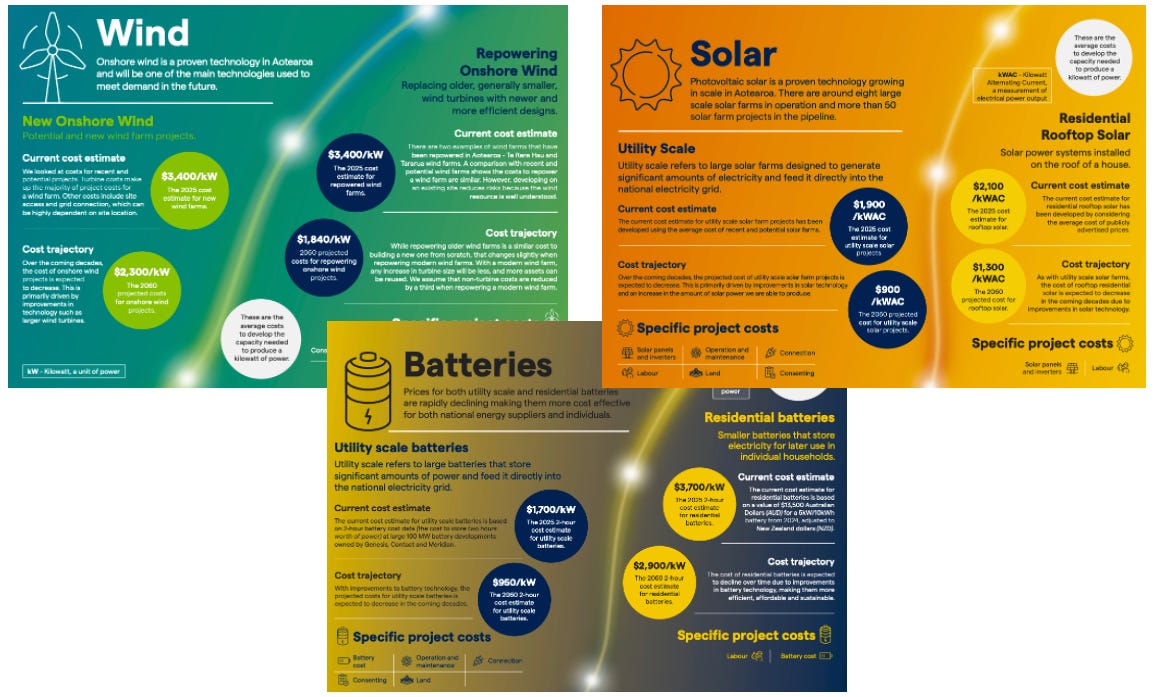
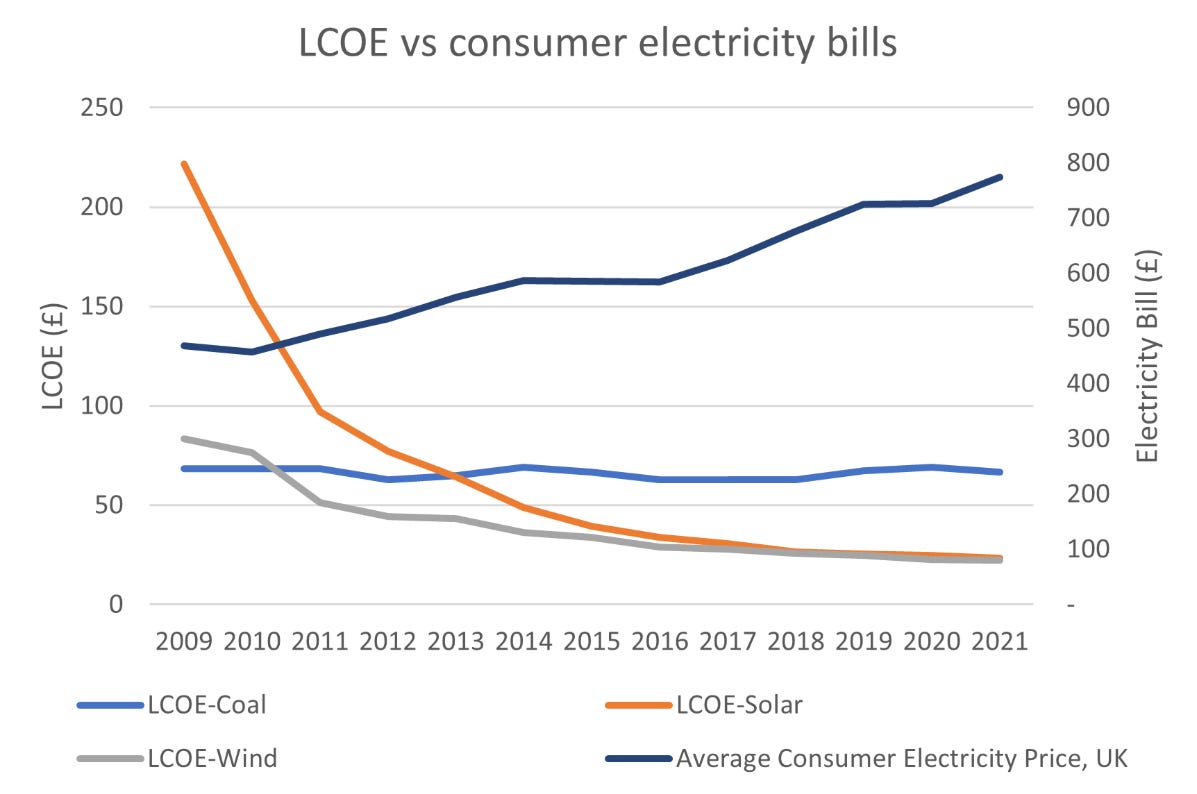
In almost every New Zealand energy discussion, from MBIE strategy papers to investor presentations, one idea is the bedrock that all future predictions are built on - that solar panels, wind turbines, and batteries will keep getting cheaper.
This assumption underpins our policy optimism. It is the critical ingredient in the narrative that we can have a prosperous growing economy powered by wind and solar.
If technology costs keep falling, the transition will largely fund itself due to the essentially zero short run marginal cost of generation. The system costs, storage and complexity will not be an issue, and easily absorbed, because the hardware is so cheap and the energy is free.
But what if that’s not guaranteed?
I don’t claim to know what the future will bring, nobody does, but I do pay attention to the fundamentals and the fundamentals are suggesting the downward cost trend may be nearing its limits. If that’s true, it has big implications for how we plan our energy future.
Solar: Still Cheap, but Why?
Solar power is remarkably inexpensive today, that’s undeniable.
But the reasons are not purely technological. Global oversupply, heavy Chinese state support, and a near-monopoly on manufacturing have pushed module prices to record lows.
At the same time, material costs tell a different story:
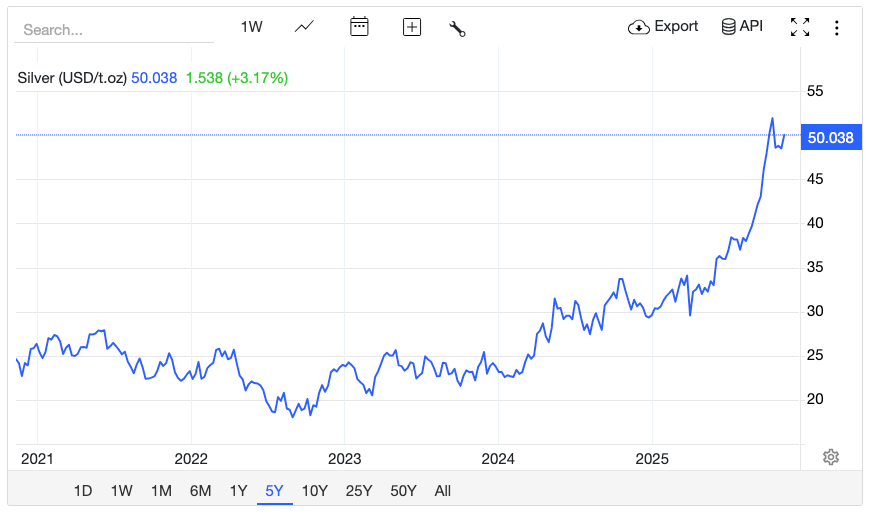
Silver, a critical conductor in panel manufacturing, has seen prices roughly doubled since 2020. According to the Silver Institute, silver prices rose from approximately US$24/oz in early 2020 to around US$50/oz in early 2024.
Polysilicon, the dominant material in solar panels production remains energy-intensive and carbon-heavy.
Much of the downward cost pressure in recent years is a function of oversupply out of China. The International Energy Agency reports that despite a warehoused stock of 150GW of solar panels heading into 2024. Manufacturers continued to deliver low-price modules to markets in an effort to secure cash flows, and so module prices continued to decrease across 2024.
Margins are razor thin and several Western manufacturers have exited the market. China now produces over 80% of the world panels. China also controls the global panel supply chain for all major stages (polysilicon, ingots, wafers, cells, modules) with some projections indicating that they will achieve a 95% market share in some of the more energy intensive categories.
If China’s dominance was disrupted or there was an industrial policy shift, silver prices continue to rise, or coal prices rise, solar panel module prices could easily start to trend upwards.
Yes, innovation continues, perovskite tandems, improved yields, better automation. But those gains compete against real-world limits and follow the law of diminishing returns on complexity. Energy, materials, and capital costs eventually set a floor beneath every cost curve.
Wind: Learning Curve Meets Input Costs
Wind is the canary in the coal mine. For twenty years, it has been the poster child of falling costs. Now in some cases it’s going the other way. Recent studies such as Bloomberg’s New Energy Finance - Wind Turbine Price Index show a 10–15% increase in average turbine order prices from 2021 to 2023.
The causes are not mysterious:
Higher interest rates mean higher capital costs.
Steel, copper, and rare-earth inputs have surged from pre-covid levels.
Energy density, MW per resource tonnage is important here. Wind is particularly sensitive to the iron law of energy density - that low energy density equals high resource intensity.
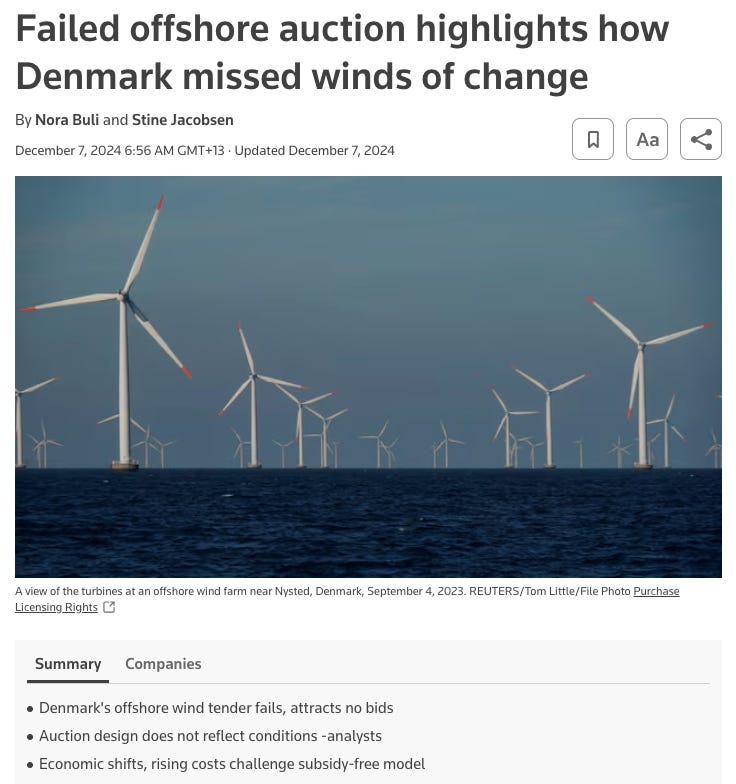
Highly disperse, low energy density wind, needs massive amounts of materials to harness, even more so when its offshore, this is where the material and cost of capital sensitivities lie.
Some of this could reverse. Particularly if interest rates fall, material costs appear to be stabilising, but it should be a reminder to us that cheap technology depends on cheap finance and cheap materials, and that era may be over.
Batteries: Falling, but Slowing
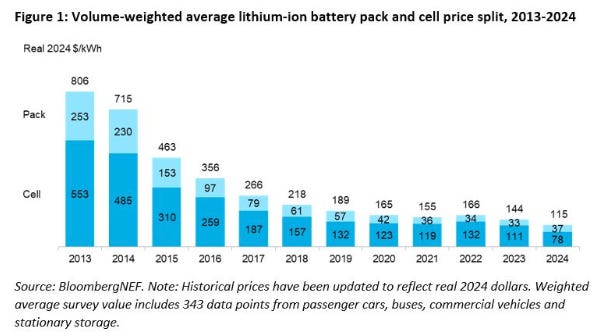
Batteries will be a critical feature of our increasingly intermittent grid. Grid scale battery systems are still relatively early in their development phase. Battery prices are still declining, though the rate of decline is starting to flatten. The early cost collapse came from manufacturing scale and process learning, not miracles of chemistry.
New chemistries like sodium-ion may eventually help, but they can’t escape the physics of energy and materials. Mining, refining, and assembling batteries consumes enormous energy, and that energy generally isn’t getting cheaper.
Emerging contenders like sodium-ion use a more abundant resource but the materials are often of a lower grade and require more energy to purify. This may result in the material advantages being partially offset by the higher refining energy demands.
So yes, batteries will likely still get cheaper for a while. But it’s fair to ask, how much further can that curve fall before it hits its energy-cost floor?
Context Matters: New Zealand as a Price-Taker
New Zealand imports all of this technology. We don’t control the factories, the minerals, or the supply chains. If the global cost floor rises, we’ll feel it directly.
All of our national plans, from Transpower’s Net Zero Grid Pathways to MBIE’s transition modelling, assume steady declines in capital costs. That’s understandable, it’s what the last decade trained us to expect.
But if the next decade looks different, our system design and pricing structures could catch us out.
Integration Where Costs Turn Non-Linear:
Even if hardware costs remain low, integration costs rise non-linearly, as the percentage of intermittent generation grows.
Beyond a certain share, every additional megawatt of wind or solar requires more backup, storage, and transmission.
This is not a reason to stop building renewables, but it is a reason to proceed with caution and plan realistically. Cheap panels don’t automatically make a cheap electricity system.
As discussed in solar surge the rapid 30MW swings in output from a 55MW solar farm as clouds pass over creates real problems for the grid. I can envisage a time when grid access requirements for generators don’t just cover voltage and frequency but also consistency of output. How many developers are testing they economic sensitivity of their developments with and without behind the meter batteries?
A Few Counterpoints Worth Remembering
I might be wrong.
History shows that human ingenuity often surprises us:
Learning curves still exist, each doubling of capacity can reduce costs through scale and efficiency.
Emerging tech such perovskites, solid-state batteries and modular turbines could all change the calculus.
But it’s also true that materials, energy, and finance have biophysical physical limits.
The more complex and capital-intensive a system becomes, the more sensitive it is to those inputs.
So, What If the Assumption Is Wrong?
What if renewables don’t keep getting cheaper?
What if the era of easy cost gains are behind us, and future progress depends more on efficiency, integration, and storage rather than hardware discounts?
This could make progress very difficult.
In a wide boundary analysis intermittent sources of energy are already at a disadvantage in terms of the net, system level, surplus energy they provide to society, or in other words they have a low EROI (Energy Return on Energy Invested). Increasing capital costs would only make this disadvantage more acute.
This wouldn’t automatically spell failure, but it would mean:
That wind, solar and battery developments become more capital-intensive, not self-funding. Margins will be narrower and risks higher.
System reliability and system cost management would matter more than levelized cost of energy headlines.
Policy shifts from “more megawatts” to “more resilience per dollar.”
We are already seeing this transpire to some extent with the shift in the government narrative from “more generation” to “more firm generation” on the back of the Frontier Economics report.
The danger is not that renewables won’t work, but that we expect them to solve everything cheaply.
Closing Thought
The fact is that NZ Inc. is betting big on wind, solar and batteries. I don’t know exactly where the cost curves of these technologies will go next, but perhaps a more pertinent question is if this bet based on a solid understanding of the fundamentals or a blind faith in technology?
The fundamentals - materials, energy, finance, and complexity — all suggest the era of effortless cost decline is not necessarily guaranteed to continue.
Maybe renewables will surprise us again, or maybe not.
Either way, it seems wise for New Zealand to treat falling cost curves as a possibility, not a promise.
If you’re sitting around a board table about to vote on a final investment decision, my recommendation would be to make sure you have tested your projects economic sensitivity to increasing costs, just to hedge your bets.
Thanks for reading as always. Apologies it has been a while since my last piece. I have been out int he hills, with good friends, enjoying so much that this wonderfull country has to offer. As always please like and feel free to share far and wide if you find these pieces useful.
Larry

If the EROI for solar farms is so low, why would you invest; the answer applies to subsidies paid by taxpayers and ratepayers; us mugs.
The Coalition Government strategy is to reset the climate agenda to a lower level of compliance but without attracting trade treaty disputes; so the politicians check the polls to determine what the voters support.
Some local news:
The Moroa Rd solar farm (adjacent to Transpowers Greytown Substation) has an Interim Consent, not a final Consent from the Environment Court. This means that the Resource Consent will be granted when a COMPREHENSIVE set of conditions have been negotiated by the Far North Solar Farm and the South Wairarapa District Council planners with the Court. The Court has given the FNSF the opportunity to "remedy areas of deficiency"; another way of identifying the FNSF as dumb grifters.
The local opposition to FNSF is well resourced with people expert in dealing with the Deep State including the gravy train grifters and of course the Woketearoa at Meridian.
The outcome of this event maybe a gold standard which will hopefully tell the Renewable Developers to get lost.
There is another perspective which readers may not fully understand. There is a Transpower single circuit 110 kV transmission line between Haywards at Lower Hutt and Bunnythorpe north of Palmerston North. I can't remember it's rating but my estimate it's about 300A or about 60 MW.
The Renewable Developers are smart enough to find out the local farmers who wish to sell or lease their land nearest to the Transpower substations such as Greytown and Masterton (also in front of the Environment Court) or are close to the 110KV line near Mt Munro which Meridian has the Consent.
Will there be a ratings issue? Who is going to pay for the additional infrastructure? Once the cheap sites are gone, wouldn't the more expensive sites mean the price of Renewable electricity will increase even further? Noting that if the wind drops and a cloud covers the sun, aren't we dependent on fossil fuels to bridge the gap? Just wondering.
Some foreign news; COP30 in Brazil; check out Matthew Wielicki podcast today about climate change hypocrisy; the reason NZ should ditch the Paris Accord.
Can't help but think that there is a disconnect between your "Mining, refining, and assembling batteries consumes enormous energy, and that energy generally isn’t getting cheaper" and the fact that China has in recent years installed a massive amount of solar generating capacity which has reduced energy costs for them throughout their manufacturing sector.
Also the degree of electrification of transportation in China is now impacted significantly in their fossil fuel consumption which will potentially destabilise international oil demand and prices so the future in terms of energy supplies and pricing has many moving parts and any crystal ball gazing is little more than just that.
The one guaranteed factor is that wind and sunlight are unlimited resources and the economics of harvesting this 'free' energy will continue to put solar and wind a step or two further up the ladder than their declining resource competitor, fossil fuels.
The problem we have here in NZ is that the major electricity generators are working within a framework that rewards scarcity of supply and use of comparatively expensive thermal generation. That regulatory platform needs to change so that renewable generation can compete fairly, and hydro capacity can be used in a huge utility scale battery capacity instead of being a weapon to hold back other renewable generation entrants.