
The Math Ain’t Mathing
Scrolling the news this morning has me scratching my head.

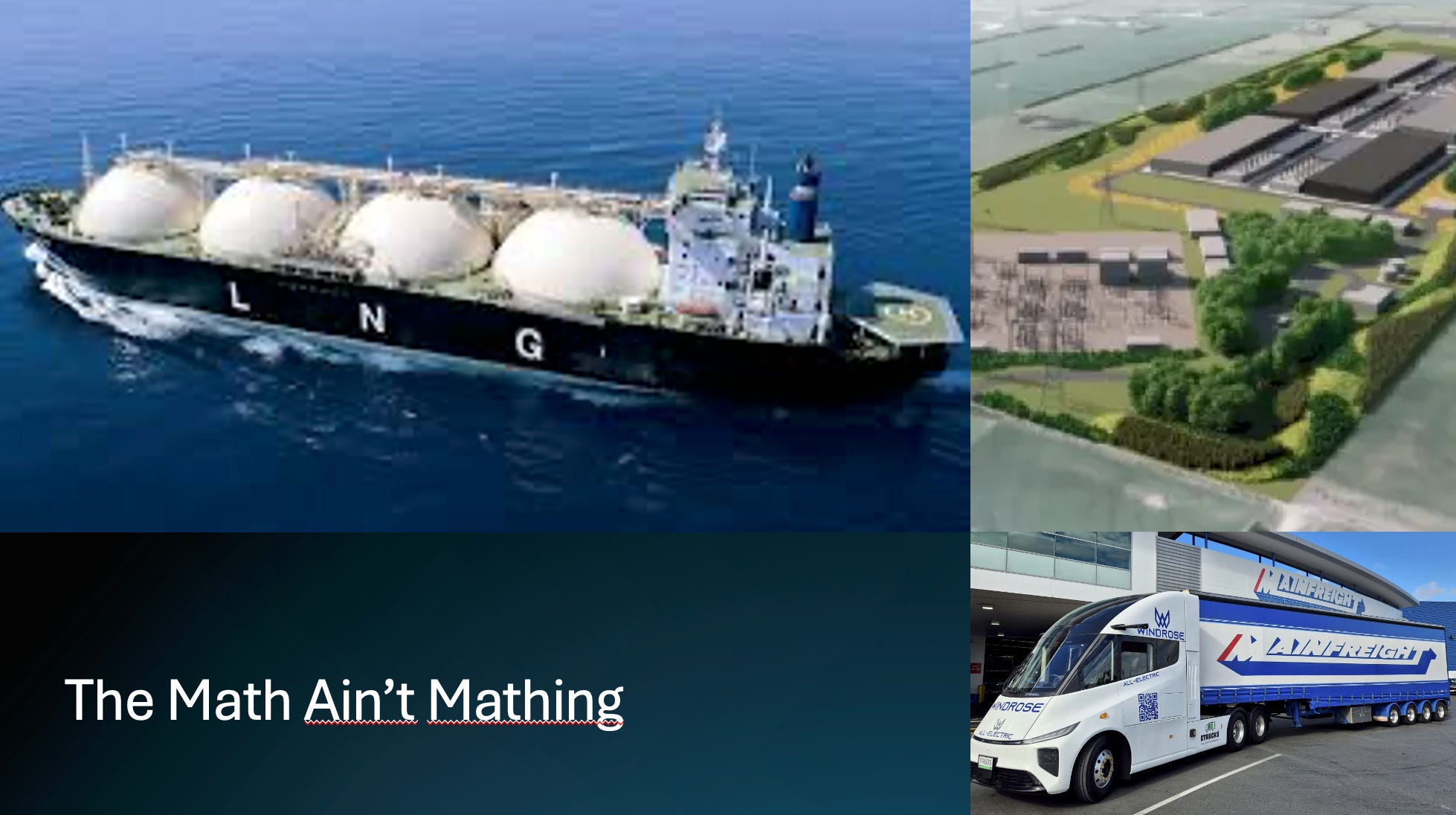
This morning, while drinking my coffee and scrolling through the news, I came across three stories that, at first glance, seemed unrelated.
But when you put them side by side, something doesn’t add up.
First, we’re told New Zealand probably doesn’t need LNG imports. The argument is that we don’t really have a dry-year problem and that declining gas production can be managed through a combination of electrification, fuel switching, and demand reduction.
Individually, they have varying degrees of plausibility.
Collectively though, the math ain’t mathing.
The case against LNG implicitly assumes a relatively stable demand outlook. If gas-using industries progressively switch to electricity or biomass, and if transport gradually electrifies, then perhaps declining domestic gas production can be managed without importing LNG.
But a 1 GW data centre changes the equation dramatically.
A 1 GW facility operating continuously would consume approximately 8.7 TWh of electricity per year. New Zealand currently consumes about 40 TWh annually. In other words, a fully developed Datagrid campus would increase national electricity demand by around 21%.
All of this from a single facility. This demand isn’t flexible. It isn’t seasonal. It isn’t a peak load that appears for a few hours on winter evenings. It’s baseload demand. Twenty-four hours a day. Seven days a week.
The challenge becomes even more obvious when we consider how that electricity would be supplied.
New Zealand’s existing hydro system already provides the firming capacity that keeps the grid stable today. There is little headroom to take on a major new baseload demand, particularly in dry years, when lake levels are already stretched to cover existing needs. To reliably supply a load the size of the proposed data centre, a major new storage project such as Lake Onslow (pumped Hydro) would be necessary to back up the additional wind and solar generation required.
Roughly speaking, supplying 8.7 TWh per year from a combination of wind and solar would require something on the order of 2.5 – 3.0GW of new renewable generation in the form of wind and solar. For context NZ currently has about 1.5GW of wind and 0.4GW of solar farms.
This doesn’t include gas users switching to electricity. It doesn’t allow for electric trucks or growth elsewhere in the economy. It’s only the data centre.
This is where the conversation often jumps from engineering to storytelling.
One story says we don’t need LNG because electricity can replace gas. Another says electricity demand is about to surge because of data centres. A third says renewable generation can effortlessly accommodate all of this without thermal firming support.
Perhaps each story contains some truth when viewed in isolation, but they cannot all be true at the same time without confronting the scale of the infrastructure required and the limitations of the technology we are trying to do it with.
If New Zealand wants large-scale data centres, industrial electrification, transport electrification, and the retirement of natural gas, then we need an honest discussion about what must be built to make that possible, and what it would cost.
The generation, the transmission, the storage and the firming capacity, together with a realistic assessment of how long all of this will take to build assuming global markets can supply the equipment given the current commodity market turmoil.
Because before we debate solutions, we need to agree on the arithmetic.
And right now, based on these three stories, the math ain’t mathing.
P.s.
If you’re finding value in these pieces, the best way to support this work is by subscribing, reading, sharing, and engaging with them.
I publish these pieces freely in the hope they help people better understand the role of energy in our lives. If you are finding these useful for your work, business decision making, and home energy choices, I’d love to hear how you’re using these insights. It helps me understand where to focus my energy and also encourages me to keep researching, if I know it’s helping businesses and my fellow kiwis.
It costs nothing to subscribe or access the full back catalogue of over 150 articles that can be found here. However, if you choose to become a paid subscriber, that’s greatly appreciated, it allows me to dedicate more time to researching and writing.
Larry
Many thanks, Larry, for directing the energy discussion towards wide-boundary thinking: “perhaps each story contains some truth when viewed in isolation” reveals what is an Achilles Heel of much of the energy debate. “If New Zealand wants large-scale data centres, industrial electrification, transport electrification, and the retirement of natural gas, then we need an honest discussion about what must be built to make that possible, and what it would cost.”
While I welcome this advocacy for widening the debate, I venture that it needs to go a fair bit wider again than what you in essence frame as the logistics and financing of an expanded electricity supply.
A clue lies in “If New Zealand wants…” – i.e. when have we had a national discussion about our long-term energy security, about whether we even want large data centres, or about the energy-constrained future we are almost certainly heading for (and how a massive data centre with a 24/7 dispatchable electricity contract affects that)? Or, wider again, whether we are operating under “minerals blindness “ when it comes to sustaining our energy and other infrastructure, how a massive data centre might help our communities flourish, or help us stop trashing the future with emissions, resource depletion, and the like.
We are racing across the threshold of wholesale systemic change and are hardly discussing what that means.
The bit I don't get is that the power companies know that this doesn't work. So who is dumb enough to sign a contract to provide a GW of power? It certainly can't be cheap at that volume. That's bankruptcy level stupidity. I would guess that once the data centre proponents get consent and try to find power they will come unstuck.