
Data Refineries
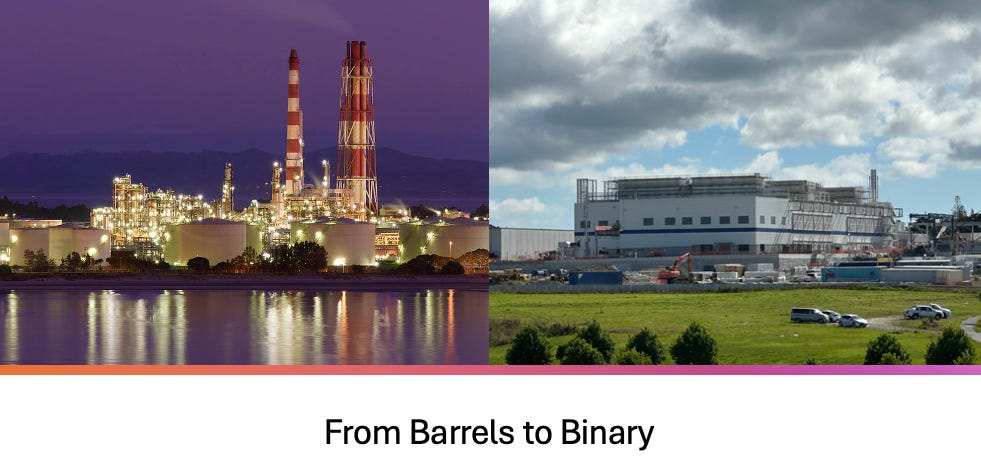
Four years after the closure of Marsden Point, is New Zealand poised to get back into the refining business?

“The fastest way to make a small fortune in a capital-intensive commodity business is to start with a large one.” — Warren Buffett
A short thought experiment today.
You may have noticed that nearly every developed nation has outsourced much of its manufacturing and energy-intensive industrial activity to the developing world. In parallel, they have increasingly financialised their economies.
New Zealand is no different. We are de-industrialising rapidly, and our economy is now heavily dependent on debt-fuelled asset price inflation to sustain the perception of growth. This is inherently unstable. With the limits of monetary policy becoming clearer, our politicians on both side of the house are searching for something beyond the Official Cash Rate to stimulate the economy.
So where do countries like New Zealand look for the industrial base of the future?
Around the world, the answer appears to be the same - big data.
More specifically, the mythical hyperscale data centre. A virtual 21st-century cash cow.
A $70 billion opportunity?
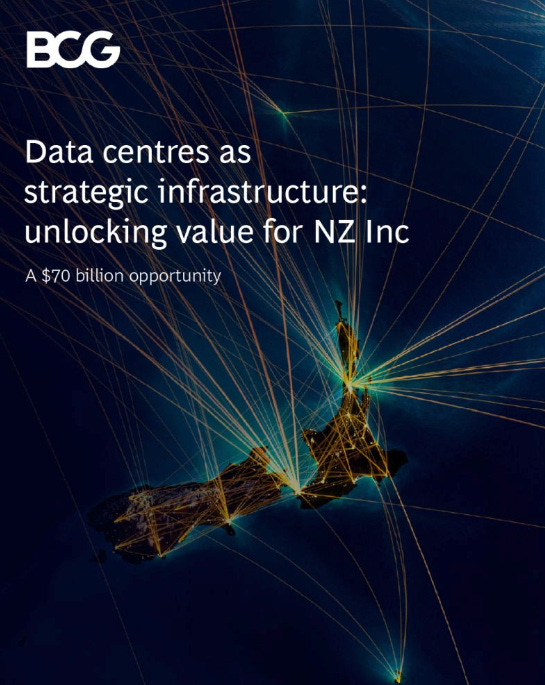
A recent LinkedIn post caught my attention. Boston Consulting Group is reportedly working on a report that frames data centres as strategic infrastructure for New Zealand, with the potential to unlock $70–100 billion in economic growth over the next decade.
Which raises an interesting question:
Are data centres potentially going to be the next low-margin refining business of the modern era?
Bear with me as I tease out this little analogy.
Oil refining is a marginal activity. The plants are hugely capital-intensive. Profitability depends on processing enormous volumes of crude at thin margins.
New Zealand’s only oil refinery, Marsden Point, closed in 2022 for precisely this reason. Structurally low margins combined with looming, capital-intensive upgrades. Marsden Point wasn’t closed because refining failed, it closed a because marginal businesses cannot justify billion-dollar reinvestment when they don’t control the value chain.
So will data centres truly add value to New Zealand, or are we simply hosting the next marginal refining business, this time converting electrons into binary code?
Hyperscalers
Big data is big business.
Today’s hyperscalers like Amazon Web Services, Microsoft Azure, and Google Cloud, operate with margins in the 20–30% range. That level of return on capital explains much of the excitement around hosting data centres.
But hosting is not vertical integration.
Hosting is commodity economics, and this time, the commodity is electricity.
Hyperscalers generate extraordinary returns because they own the platform layer. They capture network effects. They lock customers into digital ecosystems. They can innovate and launch new products at near-zero marginal cost.
If New Zealand Inc. cannot replicate that vertical integration, how much value do data centres actually add to our economy?
Who pays and who profits?
The cost of hosting data centres is substantial. They require vast amounts of cheap, highly reliable electricity. They want lots of it, and they want it firm. Geothermal, hydro, gas and nuclear are their preferred choices.
In New Zealand’s case, that implies major investment in generation, transmission, and grid infrastructure.
We will fund this through our power bills. Will we receive a proportional return in terms of economic growth?
Fully integrated oil majors struggle to sustain 10% margins over a cycle. Hyperscalers routinely exceed 25%.
Hosting their infrastructure doesn’t necessarily give us their economics. But it does give us their power bill.
The question is. Does New Zealand have the education system, knowhow, financial and tech capability to extract true value from this energy intensive industry?
Perhaps I’m simply a luddite. I’m no expert in big tech or big data by any stretch of the imagination and I’m happy to be wrong on this one. Perhaps we could avoid simply supplying electricity to offshore profits and instead fully capture the value chain of a vibrant domestic digital ecosystem?
Have at it in the comments and get me up to speed on NZ’s big tech future.
Larry
Sorry but I don't know the answer. I was trained in Engineering but my working life was in industrial control software. I'm skeptical about AI but I follow a chap called Sasha Yanshin who is a Russian financial advisor living in the UK. You might like to look at some of the first 8 of his videos about the big tech companies and how they are borrowing huge amounts of money to fund their AI ambitions and also how they are faking revenue in order to attract investors. I don't know how that ties in with the 25% margins you mentioned.
https://www.youtube.com/@SashaYanshin/videos
Our UK Prime Minister has spoken about his ambitions to make the UK a world leader in AI but seems to have no plan on how to achieve it especially since our electricity supply is increasingly dependent on renewables.
Control of the data is what the powerful desire. Supplying cheap power for other people to own/process data puts NZ right where it is with eg the aluminium smelter, milk powder supply, delivering commodity product which is bought at the cheapest possible price. Rio Tinto’s bargaining for power at Bluff makes it 100% clear how that future looks. Not to mention we need the power for our own people! It’s not like we have a lot of spare. Data centres to manage our own data - yes. For others - no.